
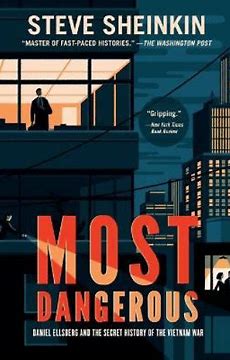
Hello readers! We are introducing a new facet of our organization: Author Interviews! We believe that learning about the story behind the creation of a widely loved novel is so important, and we want to be able to grant you all that experience. Our first author is Steve Sheinkin, an American author of multiple historical non-fiction novels, winning many different literary awards, including the Newbery Honor and the Margaret A. Edwards Award. We interviewed him about his 2015 historical non-fiction YA novel, Most Dangerous, which tells the story of Daniel Ellsberg, an American political activist, and his role in the Vietnam War and the Pentagon Papers.
To start off, our readers would love to learn about how you got into writing in the first place. What inspired you to eventually turn this talent into a career?
Great question! As a child, I loved writing stories and comics for my friends. My brother and I always wanted to make movies for a living. Eventually, I went to Syracuse University in New York, which is well known for its communications school and film and TV majors. That is what I wanted to focus on. I also started to get into history there, which was so much more compelling to me than film and involved a lot of writing and thinking. That’s when I started to get into writing, but I hadn’t yet thought of it as a profession. Anyone who tries to be a writer has to juggle a lot of different jobs. I had all kinds of different jobs, one of them being in the educational publishing world. I wrote history textbooks, which I had never liked because I found them boring, but it was good practice. Writing those textbooks taught me that that wasn’t what I wanted to do, influencing me to consider writing creatively, using personality, and humor. I was writing and finding cool stories, but I was never able to get them put into textbooks, so I wanted to start writing my own books.
Although you wrote for American history textbooks in the past, your novels center around historical figures that challenge authority. What motivates you to write about people who are determined to change the status quo?
It’s just interesting to me! People who are so divisive really appeal to me. It’s exactly what textbooks don’t show. Our history is so full of contradictions, and even the most basic facts have become so political. Most of the Founding Fathers were also slaveowners, which is a major contradiction. There are people who don’t like to talk about this side of our history, but it’s exactly the kind of story I look for. I love characters who some people think are heroes while others think they are villains –just like Daniel Ellsberg—it makes history interesting to me. When I write my novels, I do a lot of research, finding stories that I think are interesting. Someone your age probably never would have heard of the Pentagon Papers or The World’s Most Famous Filing Cabinet, but reading about something you don’t know about just makes the story even more entertaining.
Speaking of making a story entertaining, how do you balance telling a complex political story while still keeping it engaging for young readers?
To me, history is a story – and how could a story ever be boring? I am a reader who is not necessarily a historian, so to me, the historical happenings that I pick need to move fast.. Ellsberg’s life was epic, like a hero’s journey. There is so much going on that it feels like a thriller. He was in the action right from the start, and I think that can be really engaging for a younger person reading Most Dangerous. When I think of a teenager taking away something from this book in particular, it’s not so much the specifics of the story, but more about what it makes that reader think about. To me, it’s never about memorizing stories or facts, it’s more about curiosity. The story in Most Dangerous opens your eyes to so many layers of how things work in the US government, and hopefully can help people realize how much they could find out if they dug a bit deeper into the things they were passionate about. It can show a reader that everyone, no matter who they are, can make a difference in some way, and that change begins with educating oneself on what is going on in our world.
Delving more into the content of Most Dangerous, how do you think the release of the Pentagon Papers, that is the book’s main plot point, changed the way Americans view the US government?
When I write my novels, I try my best to go straight to the primary source. When I was researching the release of the Pentagon Papers in preparation to write Most Dangerous, I asked people who lived through it. I found that the whole process of the Vietnam War and America’s lies, sending teenagers into this battle for years and years, who didn’t know how to win because the president didn’t want to lose a war, changed the American attitude towards the government for the worse. Before the Vietnam War, people really used to believe stuff the government said and had more patience with it. Nowadays, people have a lot less trust in the government and in the media, and this was a big part of that change.
What challenges did you face while writing Most Dangerous, in terms of content and/or structure?
I would say the biggest challenge was that there was almost too much information. It was too easy to research in some ways because there was so much material and so many characters to cover. For example, during the second part of the book, which takes place during the Nixon Administration, most of the government recordings from that time are public, and one could get lost for months just trying to find quotes and details that make the story jump and feel like fiction. But writing and researching also take a really long time. The primary sources that I found to use were so overwhelming to narrow down into a fast-paced plot. I left out hundreds of pages of stuff. Naturally, when I write, I end up cutting stuff out because it doesn’t work or, even if it does, it’s slowing down the action of the story. When I talked to Patricia Marx, Daniel Ellsberg’s wife, she told me some stories that she asked me not to use for privacy’s sake, but they helped me learn about Ellsberg nonetheless. Also, when writing a historical novel as heavy as Most Dangerous, I have to keep in mind that the book is going to school libraries, and consider that when I’m deciding what to keep and what to cut.
What advice would you give to young people interested in writing nonfiction or exploring history in depth?
I would just start with whatever it is that interests you. You can’t always do that in school, but just start with a story that interests you. I wrote a whole book because of a tiny article on a filing cabinet. Find that thing and start digging. Imagine yourself not doing homework, but as an investigator or a detective. Try to piece together a story you’re interested in, and have fun with that process. Tell it in your own way, and you can do something totally unique. When I think about youth approaching questions of government transparency and civic responsibility, which writing nonfiction requires, it is so important to read a lot, talk to people, keep an open mind, and learn that you cannot rely on any one source to tell the full story. One has to think and understand for themselves. I have a lot of trust in young people to do that.
What do you think the role of writing and reading in younger generations and our world, and society today should be?
I think it should begin with being fun. It’s why most people read. You pick up a story because it’s entertaining, not a chore. If, along the way, you learn something and your curiosity is sparked, that’s my goal, but really, my only hope is that my books can be fun to read. As a writer and a reader, I believe that we can be entertained by literature and make it fun.
Great answer! To conclude our interview, we’re going to do a little rapid-fire.
Favorite book?
It moves around. Some books that influenced me, even though I wasn’t reading to be influenced. The Great Train Robbery by Michael Crichton, who is most famous for Jurassic Park. One of those books I wish I could read again for the first time. I go back to it all the time because it is what I am trying to do. A combo of history and thriller that is just so exciting. When I find a book like that, it sticks with me.
Favorite movie?
When I was younger, comedy movies really influenced me. Old old comedies, like the Marx Brothers, but also stuff from the 70s and 80s. I wanted to try and write those kinds of films. That’s what got me into writing in the first place. If I could make one of my books into a movie, Born to Fly would be my first choice.
Favorite author?
I wouldn’t say I have one favorite. To me, the beauty is skipping around from a thriller like that to a nonfiction to a graphic novel to an audiobook to YA. That is the best part of reading. This ability to skip around and have so many books surrounding you.
Favorite TV show?
Breaking Bad, Succession. Really good dramas that are also deeply and darkly funny. I’d watch them over and over. I never get tired of them.
Any quotes you live by?
I do have a great one. It’s from Most Dangerous. It’s by Randy Kheeler, a very minor character. He was a war protester who was sent to jail for refusing to be drafted. He gave a speech that influenced Ellsberg even though he didn’t know Ellsberg personally. When I talked to Kheeler 40 or 50 years after the fact, he told me something I’ll never forget: “Don’t let anyone ever tell you that something you do is too small to make a difference. You never know how the ripples may spread.”